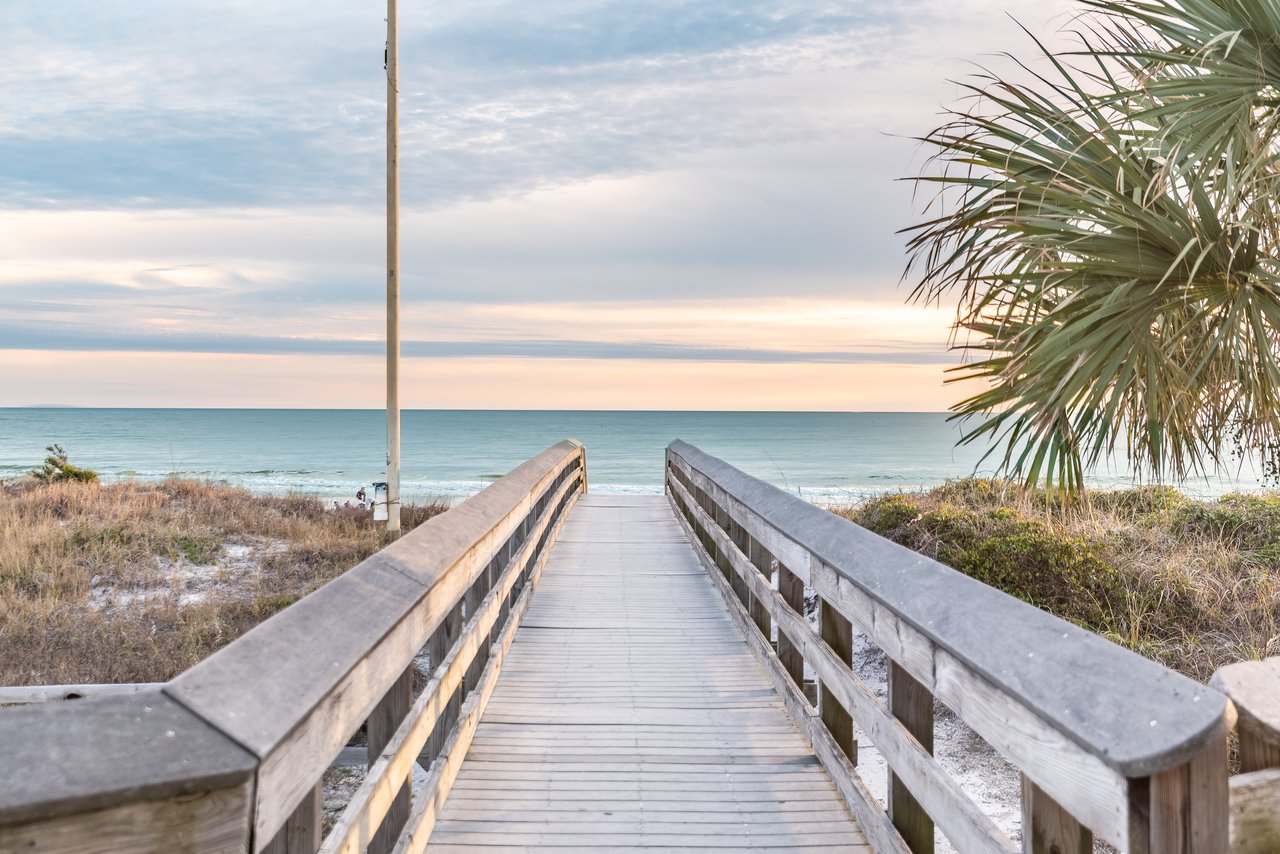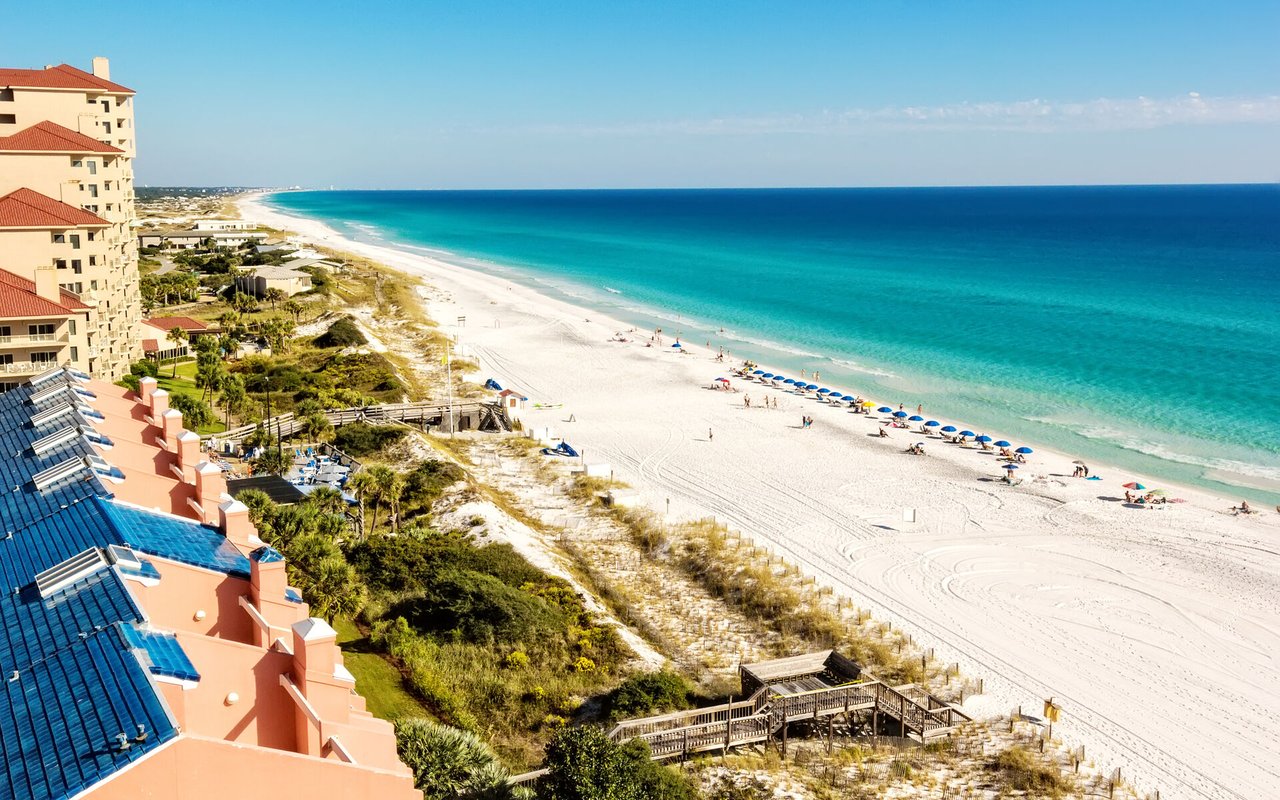
Walk your dog down Scenic Highway 98 at 4 p.m. and something odd happens depending on which side of an invisible line you're standing on. On the Miramar Beach side, your permitted, leashed dog can step onto the sand, tag jingling, and nobody blinks. Keep walking west into Destin and that same dog, same leash, same owner, becomes a code violation the moment a paw touches the beach. No permit fixes it. No amount of local standing changes it. The rule simply stops existing.
Most residents who've lived here more than a summer already know the broad strokes: dogs on the beach, evenings only, permit required. What fewer people register is why the rule works the way it does, and why a five-minute drive can erase it entirely. The answer isn't a city ordinance about pets. It's a county line, and it's worth understanding if you own a dog, know someone who does, or just want to explain to a visiting friend why their pup can't join you at sunset.
The Line Down Scenic Highway 98
Miramar Beach sits in Walton County. Destin sits in Okaloosa County. That's the entire mechanism. Walton County is the only county on this stretch of the Emerald Coast that allows dogs on its public beaches at all, and it does so through an annual permit system administered by Walton County Code Compliance. Cross into Okaloosa County and public beaches are closed to dogs outright, permit or not, resident or not.
This isn't a minor technicality. It means two neighbors who carpool to the same restaurant on Harbor Boulevard can have opposite legal realities for their dogs depending on which side of the county line their house sits. It's also why the question comes up so often in local Facebook groups and why the answer people give each other is frequently out of date or just wrong. The rule that actually governs Miramar Beach's sand isn't a beach rule at all. It's a residency-and-property-ownership rule tied to a specific government office, and it only applies once you're standing on the Walton County side of that line.
The Window That Doesn't Move Anymore
Here's the part that trips up even longtime locals. For years, the hours when leashed dogs could be on Walton County beaches shifted with daylight saving time, which meant the "safe window" in January wasn't the same window in July. That inconsistency got fixed. Walton County standardized the rule so permitted dogs can be on the beach, leashed, between 3:30 p.m. and 8:30 a.m., 365 days a year. No seasonal math, no guessing based on sunset.
That's a roughly seventeen-hour window that's open and a seven-hour window, midmorning through midafternoon, that isn't. If you've been avoiding beach walks in the afternoon out of habit rather than certainty, that habit is correct. If you've been telling out-of-town guests the hours change with the clocks, that's the version that used to be true and no longer is.
The leash requirement isn't optional texture. It's enforced, and the ordinance treats it seriously enough that sharing your dog's tag with someone else's dog is its own violation, punishable by revocation of your permit. Walton County built that provision in specifically to stop tags from being passed around informally, since the whole system depends on each permitted dog having its own rabies documentation on file.
What the Permit Actually Costs You
The mechanics are simple once you've done it once. A Walton County dog beach permit costs $40 per dog per year, and every permit runs on the same calendar regardless of when you first applied: valid August 1 through July 31, with renewal due every August 1 whether your dog got its tag in June or January. Lost your tag? A replacement runs $10.
For the current cycle, Walton County opened 2026 applications on May 1, with permits available for pickup starting May 15 at the Code Compliance office at 46 Coastal Centre Blvd in Santa Rosa Beach, Monday through Friday, 8 a.m. to 4:30 p.m. If your dog is already tagged for this cycle, you're set until next August. If you're new to the area or just getting a dog for the first time, you'll need:
- Proof of Walton County residency or property ownership, such as a driver's license, tax receipt, deed, lease agreement, or voter registration showing a Walton County address
- A current rabies vaccination certificate, with the owner's name matching the name on the application
- If the property is owned through an LLC, proof of controlling interest or written consent from co-owners
You can apply online or in person, and permits can be mailed or picked up. Mailed permits take two to three weeks, which matters if you're trying to time a trip to the beach around a specific week.
When the Sand Is Off Limits
The seven hours when the beach itself is closed to dogs aren't dead time. Miramar Beach has a handful of genuinely leash-friendly spots that don't run on the same clock as the shoreline.
- Haugen Park, a small wooded park backed by the bay, has a boardwalk, benches, and picnic tables and welcomes leashed dogs any time of day.
- The Village of Baytowne Wharf allows leashed dogs throughout its restaurants and retail corridor and has built an entire event around it with its Annual Mardi Gras Dog Parade.
- Grand Boulevard's farmers market is dog-friendly on market days, which makes it an easy midday errand-and-walk combination if you're avoiding the sand until 3:30.
- Scenic Gulf Drive itself, the promenade running along the corridor, is a walkable, pet-friendly stretch that doesn't require a beach permit at all since you're not stepping onto the sand.
If you're looking for more on what's happening at Grand Boulevard specifically, we've written a fuller guide to its current season.
Why This Matters More Than It Sounds
None of this is abstract trivia. It's the kind of detail that decides whether a Tuesday morning walk with your dog ends in a pleasant hour on the beach or a conversation with a code enforcement officer, and it's the kind of thing visiting friends and family need to hear from you directly, because the version they find on a quick search is often the outdated hours or the wrong county entirely. Understanding that Walton County's system, not city limits or general Emerald Coast custom, is what makes Miramar Beach's dog-friendly beach possible also explains why that privilege doesn't travel with you the moment you cross into Destin. It's not that Destin dislikes dogs. It's that Okaloosa County never built the permit system that makes Walton County's version work.
If you already have a tag on your dog's collar, you likely didn't need this explanation. But if you're new to Miramar Beach, hosting guests who brought their dog, or just tired of giving people the wrong hours from memory, this is the version that matches the actual ordinance, not the version that's been passed around informally for years.
For more on what makes life in this stretch of the Emerald Coast specific rather than generic, from local rules like this one to the neighborhoods behind them, the Marie Babin Team keeps close tabs on both. If you're weighing a move here yourself, or just want a local's read on a specific pocket of Miramar Beach, connect with our Coastal Experts and we'll walk you through it the way we'd walk a neighbor through it, permit rules included.
This article is general information, not legal, tax or financial advice. Consult a qualified professional about your situation.