The surface story on Destin condos in 2026 reads like a buyer's market. Redfin put the March 2026 median sale at $618,000 with 111 days on market. Movoto's April 2026 read landed at a $675,000 median with 83 days on market. Zillow's Home Value Index for Destin sits at $645,130 as of late June 2026, up less than one percent year over year. Houzeo counts roughly five months of supply. Every one of those numbers, taken alone, points the same direction: buyers have leverage, sellers are patient, and prices have flattened.
That reading is only half right, and the half it misses is the half that decides what a Destin condo actually costs to own. Inside the same 32541 ZIP code, two condo markets are now running in parallel. One behaves like a normal, financeable, buyer-favorable resale market. The other behaves like a distressed asset class. The line between them is a state statute, a building age, and a single funded-percentage number buried in an engineering report.
Two Markets Inside One ZIP Code
The bifurcation shows up first in list-price-per-square-foot data. Realtytrac's recent snapshot showed Destin condo list price per square foot climbing 9.38% week over week while single-family only ticked up 1.93%. That looks like condos are strengthening. Read against the days-on-market gap, it tells a different story: buyers are actively transacting on the condos that clear a due-diligence bar, while the ones that don't sit for months and drag the aggregate DOM upward.
Here is the split, translated to what a buyer is actually looking at on any given tour:
| Condo profile | Building age | HOA position | Typical 2026 experience |
|---|---|---|---|
| Newer or well-reserved | Post-2000, or older with SIRS-compliant funding | Reserves fully funded, no pending assessment | Standard financing, negotiable but competitive, DOM in line with single-family |
| Milestone-flagged | Coastal mid-rise or high-rise built before 2001 with reserve waivers on record | Phase 1 findings pending or Phase 2 triggered, reserves below SIRS-required level | Cash-heavy buyer pool, longer DOM, price cuts, questions about warrantability |
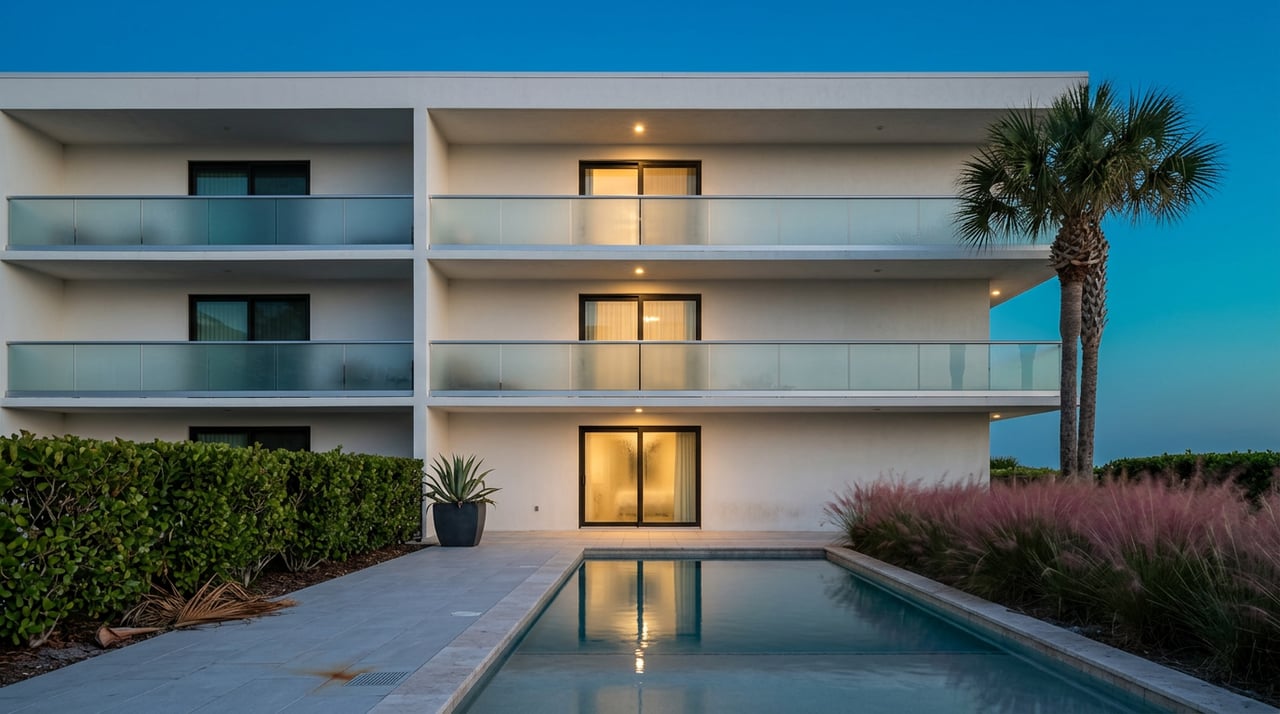
Same ocean, same emerald water, same view from the balcony. Different total cost of ownership by tens of thousands of dollars.
The Deadline That Rewrote The Math
The mechanism sitting under all of this is Florida's post-Surfside legal framework. Senate Bill 4-D, refined by SB 154 and most recently amended by HB 913 in 2025, requires a milestone structural inspection for any condominium or cooperative building three habitable stories or taller. For buildings within three miles of the coast, and Destin's Gulf-front and Harbor towers all qualify, that inspection is triggered at 25 years from the certificate of occupancy rather than the inland 30. The Florida DBPR's condominium division confirms the Structural Integrity Reserve Study, the SIRS, must be completed no later than December 31, 2026.
Two dates matter for a buyer walking a Destin condo this year.
As of January 1, 2026, associations subject to the SIRS may no longer waive reserves for the eight mandatory structural components: roof, load-bearing walls and primary structural members, floors, foundation, fireproofing and fire protection, plumbing, electrical, waterproofing, and windows and exterior doors.
For decades, the standard playbook in older coastal buildings was to vote reserves down and keep dues low. That option is gone for structural components. Buildings that spent twenty years underfunding are now catching up in a single budget cycle, either through steep dues increases or through a special assessment written directly to owners.
The scale of those assessments is not theoretical. Reporting on Florida condo assessments during 2025 and early 2026 has documented per-unit charges from $5,000 for minor concrete work up through $30,000 to $75,000 for combined roof, waterproofing, and concrete restoration, with a handful of high-rise projects producing assessments above $100,000 per unit and outlier cases reported near $175,000 and higher. Phase 1 inspections themselves run $8,000 to $150,000 depending on building size before any repair scope is defined; a triggered Phase 2 adds $40,000 to $250,000 or more. None of that shows up on a Zillow tile.
What A $600,000 Median Buys Right Now
The headline median stops being useful the moment you understand what it is averaging. In 2026 Destin, $600,000 to $700,000 lands a buyer in one of three very different situations:
- A newer three-bedroom condo in a resort community where the SIRS was baked in from opening, monthly dues are 10 to 20 percent higher than a 2021 equivalent, and no catch-up assessment sits on the horizon.
- A remodeled two-bedroom Gulf-view unit in a well-run 1990s building where the board funded reserves ahead of the deadline, dues rose measurably in the last budget cycle, and Phase 1 came back clean.
- A same-square-foot, similar-view unit in an adjacent building where the board is still fundraising for a Phase 2 repair scope, insurance renewal terms are unresolved, and lender questionnaires are coming back with warrantability flags.
The first two are true buyer's-market opportunities. The third is a cash-only transaction pretending to be a mortgage transaction, and the price on the listing sheet does not reflect what the owner will owe on July 1 of next year.
The Three Documents That Decide Everything
Under Florida statute, a condo association is required to produce these on request. If they arrive slowly or arrive incomplete, that is data too. Before an offer, and certainly before contingencies are waived, a Destin condo buyer in 2026 should have all three in hand:
The Phase 1 milestone inspection report. The engineer's summary and any "immediate action" items tell you whether Phase 2 is coming. A clean Phase 1 in a coastal 25-year building is genuinely valuable. Multiple flagged items mean the real cost has not been quantified yet.
The SIRS, read for its funded percentage. The number that matters is not whether a SIRS exists, it is how funded the reserve is against what the study requires. Industry benchmarks put 70% or higher in the low-risk band, 30 to 70% in the "expect measured dues increases" band, and below 30% in the "special assessment likely" band. A SIRS showing the roof at three years of remaining useful life and 15% funded is a four- or five-figure bill waiting to be levied.
Five years of special assessment history plus anything pending or discussed in board minutes. A pattern of small assessments points to a reactive board. A quiet history followed by a pending large one usually means the building either ran itself well or ran itself into a corner. The board minutes will tell you which.
Add the current master insurance policy and any carrier notice, since post-SB 4-D insurers are using milestone outputs to price premiums and a few carriers have stopped writing older non-compliant buildings entirely. When an insurance question sits unresolved, the HOA fee line item on a lender's PITIA calculation cannot be finalized, and the mortgage cannot close.
How This Shows Up In The Rental Numbers
Investors reading Destin as a short-term rental play are seeing the same bifurcation on the income side. AirROI's 2026 dataset for Destin, covering April 2025 through March 2026, showed roughly $48,950 in average annual revenue at a $454 ADR and 39.2% occupancy across 3,844 active listings, with supply up 80.1% year over year. Miramar Beach's AirDNA read for the twelve months ending May 2026 showed 9,269 active listings averaging $43,500 in revenue, with revenue down 17.5% and occupancy off 3.7% year over year while ADR crept up 2.4%.
Two things are happening at once. Supply has grown faster than demand, compressing average revenue per listing. And underneath that average, the buildings drawing repeat guest bookings are pulling further ahead of the ones fighting insurance issues, deferred common-area work, or assessment noise on ownership websites. A pro-forma built on a market average will overstate income in a milestone-flagged building and understate it in a well-run one.
The Contract Clause Most Buyers Skim
Florida's standard condo purchase contracts allocate assessments by the date they are levied. An assessment approved by the board before the effective date of the contract is generally the seller's responsibility. One levied after the effective date typically becomes the buyer's. In a building where a Phase 2 remediation plan is in draft form and a board vote is on the calendar, the difference between signing on a Tuesday and signing on a Friday can be tens of thousands of dollars.
This is exactly where a local closing coordinator and a Florida community-association attorney pay for themselves. Neither is optional in a 2026 Destin condo purchase involving any building older than 2001. The Marie Babin Team's buyer process is built around exactly these coastal-condo diligence questions, and our neighborhood pages for Destin and adjacent resort communities track building-level context that never makes it into a portal listing.
FAQ
Does SB 4-D apply to Sandestin's low-rise villas and Kelly Plantation single-family homes? The milestone inspection and SIRS reserve requirements apply to condominium and cooperative buildings three habitable stories or taller. Two-story townhome projects, most villa configurations, and detached single-family homes fall outside the statute, though HOAs governed by Chapter 720 face their own reserve pressures.
If a special assessment is pending but not yet voted, who pays it? Under most Florida condo purchase contracts, the trigger is the date the board levies the assessment, not the date it is first discussed. An assessment approved before the effective date is the seller's. One approved after typically becomes the buyer's. Read the assessment-allocation clause with an attorney before signing, especially in buildings where board minutes reference a pending vote.
Can I still get a conventional mortgage on an older Destin Gulf-front condo? Yes, if the building has passed its milestone inspection, is funding reserves in line with its SIRS, and holds warrantable status with Fannie Mae or Freddie Mac. Buildings that fail warrantability review become cash-only or non-QM territory, which narrows the buyer pool at resale.
Is the SIRS deadline actually December 31, 2026? That is the outside date the DBPR has stated for completing the Structural Integrity Reserve Study. Buildings required to complete a milestone inspection on or before that date may complete the SIRS simultaneously, but the SIRS cannot be completed after December 31, 2026.
Buying a Destin condo in 2026 is a very different transaction than buying one in 2019, and a different transaction again from buying a Sandestin single-family home this quarter. The median tells you almost nothing. The Phase 1 report, the SIRS funded percentage, and the last twelve months of board minutes tell you almost everything. If you are weighing a specific building, or comparing two units at similar prices with very different underlying stories, the team at Marie Babin has walked coastal-condo buyers through this diligence since well before the deadline dates were on the calendar. Connect with our coastal experts and we will read the building before you write the offer.